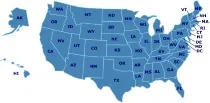
Most education officials publicly claim that teachers need special “qualifications” in order to be effective. As a result, public education organizations often promote legislation or an interpretation of the law which would require home school parents to have one of three qualifications: 1) a teacher certificate, 2) a college degree, or 3) pass a “teacher’s exam.” Although this seems reasonable on the surface, such requirements not only violate the right of parents to teach their children as guaranteed by the First and Fourteenth Amendments, but virtually all academic research documents that there is no positive correlation between teacher qualifications (especially teacher certification requirements) and student performance.
The first step in understanding the state of education today is to review how government came to be the dominant force behind schooling in the United States. From the outset of the first settlements in the New World, Americans founded and successfully maintained a decentralized network of schools through the 1850s. Then, beginning in New England, a wave of change swept across the country, which soon saw states quickly abandoning the original American model of decentralized, private education in favor of government-funded and operated schools.
This set of books is unlike any other textbooks. Each text is written in the style of a novel with a humorous story line. Each section tells part of the life of Fred Gauss and how, in the course of his life, he encounters the need for the math and then learns the methods. Tons of solved examples. Each hardcover textbook contains ALL of the material – more than most instructors cover in traditional classroom settings. Includes tons of proofs. Written by Dr. Stanley Schmidt with the intent to make math come alive with lots of humour, clear explanations, and silly illustrations that stick in the mind. The student will learn to think mathematically. Completion of this series prepares student for third year college math.
Children’s ability to understand mathematics takes a big leap forward in the preschool years. Their strengthening ability to represent using manipulatives, symbols, and signs opens up many new possibilities. Children also make strides in algebra and patterning. They can sequence events in time by age three. By age four, they can re-create patterns or make their own repeating pattern. During the preschool years, the child’s ability to problem solve takes on a new zeal. Children’s ability to classify objects is more developed; they can sort and organize objects into different categories and tell which pile has more. This chart details the skills that children can exhibit at different ages.
The Honolulu Academy of Arts is located in a historic building not far from downtown Honolulu or Waikiki. With its full schedule of studio art classes, gallery tours, school programs, family activities, as well as a film and performance series, the Academy is ever-changing. Among the most notable features of the Academy's permanent holdings of 35,000 works are the James A. Michener Collection of ukiyo-e prints and the Samuel H. Kress Foundation collection of Italian Renaissance paintings. Traditional arts of Africa, the Pacific and the Americas are also well represented, as are textiles and 17,000 works on paper.